Zero Trust: Why the Perimeter Firewall No Longer Protects Your Company
Zero Trust Architecture
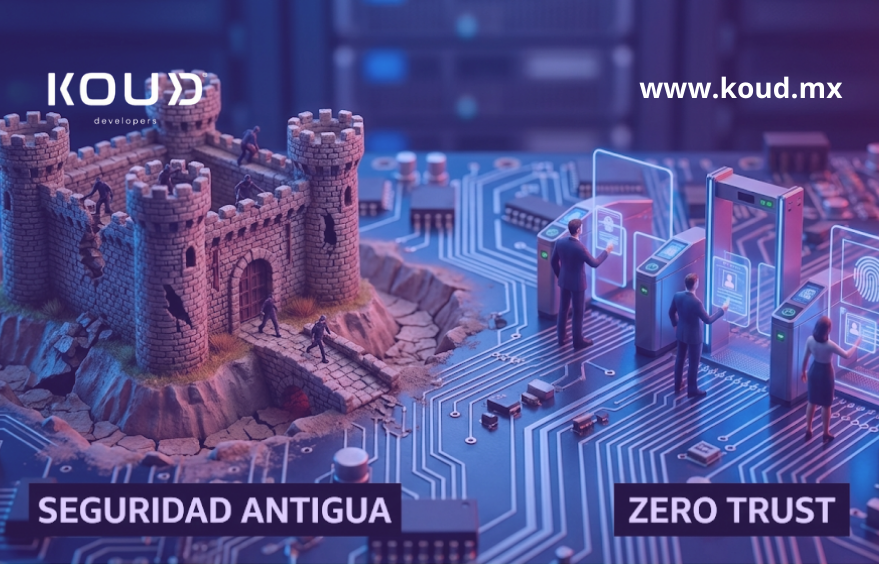
For decades, corporate cybersecurity was based on the “Castle and Moat” model. The logic was simple: everything outside the building (the Internet) is bad, and everything inside (the local network) is good and trusted. We spent millions on perimeter firewalls to build higher walls.
But the world changed. With the massive adoption of remote work, the cloud, and mobile devices, the physical perimeter has vanished.
Today, your employees access critical data from coffee shops using insecure Wi-Fi networks and SaaS services you don’t control. If you still rely on the castle model, you have a serious problem: once an attacker manages to cross the wall (perhaps through a simple phishing email to an employee), they have “the keys to the kingdom.” They can move laterally throughout your network, jumping from server to server without anyone stopping them, because the network “trusts” them.
This is where Zero Trust Architecture comes in.
It is not software you buy in a box. It is a strategic mindset: “Never trust, always verify.” In this model, it doesn’t matter if the request comes from the CEO’s computer inside the main office; the system must treat that request with the same suspicion as if it came from an anonymous hacker on another continent.
The 3 Pillars of Zero Trust (According to NIST)
To implement a real strategy based on the NIST 800-207 standard on Zero Trust, we must base ourselves on three non-negotiable principles:
1. Verify Explicitly
Identity is the new perimeter. We no longer trust IP addresses. Every access attempt must be authenticated and authorized based on all available data points:
- User identity (Is it who they say they are?).
- Device health (Is the antivirus updated?).
- Context (Why are they connecting at 3 AM from an unusual country?).
- MFA (Multifactor Authentication): It is no longer optional; it is mandatory.
2. Least Privilege
We limit user access to only what is strictly necessary and only for the time they need it (Just-in-Time Access). If a developer needs access to the production database to fix a bug, we give them access only to that database, for 1 hour, and then the permission expires. This stops lateral movement in case of infection.
3. Assume Breach
This is the hardest part for many managers to accept. We design security assuming that we have already been hacked. Instead of waiting for the alarm to sound, we segment the network, encrypt data at rest and in transit, and monitor constantly to minimize the “blast radius” of any incident.
Implementing Security by Design with Koud (DevSecOps)
The most common mistake in software development is leaving security for the end, like a coat of paint applied before handing over the house.
At Koud, we integrate security from the first line of code. We call this DevSecOps.
- Secret Management: We never allow credentials or API keys written in the source code (Hardcoded). We use security vaults (like AWS Secrets Manager or HashiCorp Vault) that inject credentials only at runtime.
- Automated Scanning: Our CI/CD pipelines include tools that scan for vulnerabilities in libraries (SCA) and in the code itself (SAST) every time a developer saves a change.
- Immutable Infrastructure: If a server is compromised, we don’t “clean” it. We destroy it and deploy a new, clean one automatically in seconds.
Koud vs. Insecure Development:
While other providers deliver functional software full of accidental backdoors (open ports, default admin users), Koud delivers digital assets armored by design.
Practical Case: Killing the VPN
The traditional VPN (Virtual Private Network) is the enemy of Zero Trust. A VPN is like a tunnel: once you cross it, you have access to the entire internal network. If an attacker steals an employee’s VPN credentials, they have access to everything.
The Evolution:
At Koud, we help companies migrate towards an Identity-Aware Proxy (IAP) or ZTNA (Zero Trust Network Access) model.
Instead of connecting the user to the “network,” we connect them to the “specific application.”
- The user logs into a secure web portal.
- They verify their identity with their fingerprint (MFA).
- The system gives them access only to the CRM but blocks access to the Finance ERP and database servers.
Tangible Benefit:
Reduction of the attack surface by 80% and improved user experience (no slow VPN clients to install).
Frequently Asked Questions
Does Zero Trust mean I don’t trust my employees?
No. It means you don’t trust the connection or the device by default. Your employees are human and can be victims of phishing. Zero Trust protects the company and the employee, ensuring that a human error does not turn into a corporate catastrophe.
Is it very expensive to implement Zero Trust?
You don’t buy “a box” of Zero Trust. It is a journey. You can start by implementing MFA (which is often cheap or free) and segmenting your critical applications. The initial investment pays for itself by avoiding the million-dollar cost of a Ransomware attack.
Does it affect application performance?
On the contrary. By eliminating VPNs that route all traffic through a slow central hub and using secure direct access to the cloud, latency usually decreases, and the user experience improves.
Conclusion
Modern security is not about building higher walls, but about putting smart doors in every room. Identity is the new frontier.
In a world where work is hybrid and threats are constant, adopting a Zero Trust Architecture is not a luxury option; it is a survival requirement.
Do you need software architects who understand offensive and defensive security?
At Koud, we build software that defends itself Consult our DevSecOps services