API Integration: Connecting Your Legacy ERP with Modern Apps
REST API Development
The scenario is classic in mature companies: You have a robust ERP (like SAP R/3, Oracle E-Business Suite, or even an AS/400) that is the financial heart of the company. It works, it’s stable, and it holds 20 years of history. But it has a serious problem: it is mute.
It doesn’t communicate with your new online store, it doesn’t send data to your sales reps’ mobile app, and it forces your team to export Excel files and manually recapture data. You have “data silos.”
Many believe the only solution is a multi-million dollar ERP migration. At Koud, we propose a smarter, more agile alternative: REST API development and Middleware layers.
The Danger of Data Silos
When your systems don’t talk, your business loses speed. Legacy system integration stops being a technical luxury and becomes an operational necessity when:
- Web stock doesn’t match warehouse stock.
- Sales sells products that Purchasing hasn’t restocked.
- Finance doesn’t see e-commerce transactions until month-end closing.
The goal isn’t to throw your ERP in the trash, but to teach it to speak modern languages.
Middleware: Your Company’s Universal Translator
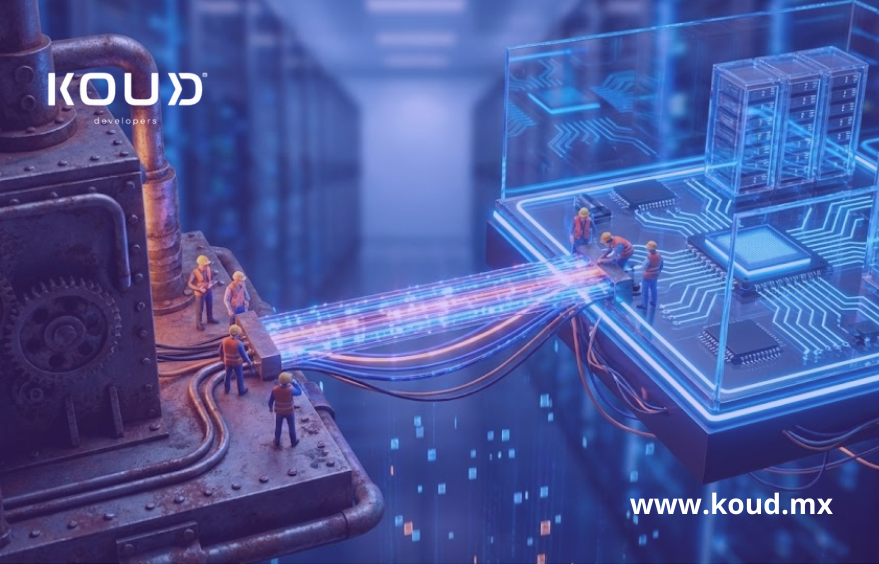
Imagine a simultaneous translator sitting between your “old” ERP and your “young” Apps. That is Enterprise Middleware.
At Koud, we develop this intermediate layer that handles:
- Extract: Pulling information from the ERP (via direct DB queries, flat files, or stored procedures).
- Transform: Converting that complex data into lightweight formats (JSON).
- Expose: Creating secure access points so any external app can consume that data.
The Challenge: Connect SAP with App
One of the most frequent use cases is to connect SAP with app for sales forces. SAP is complex and rigid; a mobile App needs to be fast and flexible.
Through our APIs, the App asks the Middleware “How much stock is there?”, the Middleware asks SAP in its native language (BAPI/RFC), receives the answer, translates it, and delivers it to the App in milliseconds. The end user never knew what happened behind the scenes, only that it works.
Why REST API? Security and Scalability
REST API development is the industry standard today due to its lightweight nature and web compatibility.
Unlike direct database connections (which are a huge security risk), a well-designed API acts as an armored window: it only delivers requested information, validates credentials, and protects your business core from unauthorized access.
Frequently Asked Questions
Is it necessary to stop ERP operations to integrate APIs?
No. The development of the integration layer happens in parallel. Only a minimal maintenance window is required to deploy the final connection, but daily operations are not affected.
What if my system is very old and lacks documentation?
Our software architects are experts in “code archaeology.” We analyze databases and existing logic to map business entities and create the necessary documentation for modernization.
Does integration work in real-time?
Yes. REST APIs allow synchronous transactions (real-time) for critical things like inventory, or asynchronous for heavy processes like historical reports.
Conclusion
Don’t let old technology hijack your company’s innovation. You don’t need a new ERP to have a modern company; you need better communication bridges.
With REST API development and Koud’s integration strategy, you can extend the lifespan of your current investment while offering cutting-edge digital experiences.