Supply Chain Management: Connecting Distribution Centers (Veracruz - Tepic)
Logistic ERP integration
For large logistics and distribution companies in Mexico, geography is the first challenge. You have a massive Distribution Center (DC) receiving containers at the Port of Veracruz and another strategic center in Tepic or Guadalajara distributing to the North and the Pacific.
Physically, they are connected by highways. Digitally, they are often isolated islands.
The common problem CIOs face is “Inventory Blindness.” The Veracruz DC uses an old WMS (Warehouse Management System); the Tepic one uses SAP; and the transport fleet uses a proprietary GPS system.
Result: The Logistics Director cannot answer a simple question: “How much total inventory do we have in transit right now?”
The lack of logistic ERP integration causes you to have stagnant stock in the Gulf while running out of product in the Pacific, losing sales and increasing storage costs.
The solution is not to replace all your systems with a new one (which is expensive and risky), but to implement a Logistics Control Tower. At Koud, we build the software layer that sits on top of your current systems and makes them speak a single language.
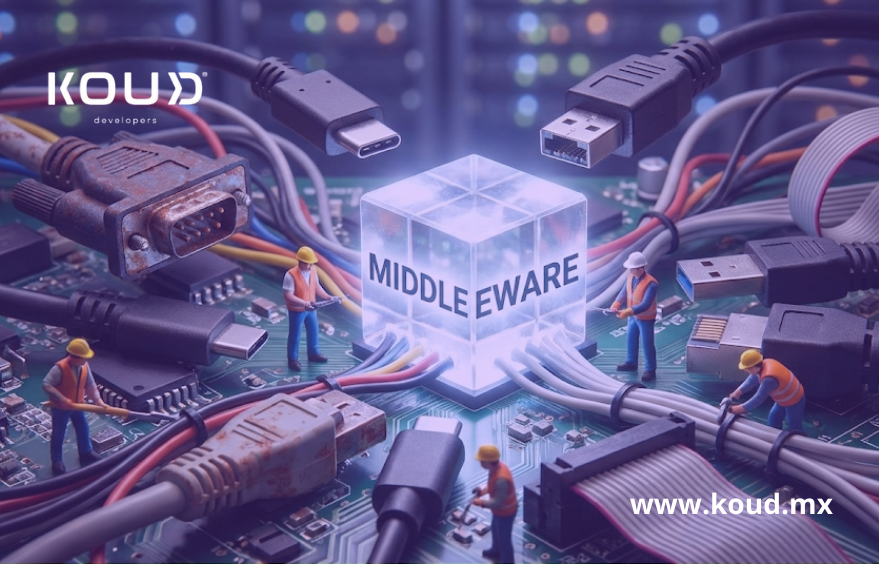
Middleware: The Universal Translator for Your Company
Your financial ERP (say, Oracle NetSuite) is excellent for billing but terrible for tracking trucks. Your TMS (Transportation Management System) is great for routes but knows nothing about accounting costs.
Trying to connect them “point-to-point” creates a digital spaghetti of cables that breaks with any update.
Koud develops Custom Middleware. Imagine it as a real-time universal translator.
- The WMS in Veracruz says: “Container X arrived” (in its technical language).
- Koud’s Middleware takes that message, translates it, and tells SAP: “Increase asset on books” and the TMS: “Schedule a truck to pick it up.”
Koud Approach: Robust and Scalable Integrations
In the Mexican logistics corridor, connectivity is not always perfect. A truck crossing the mountains will lose signal.
If your integration depends on being “always online,” it will fail.
At Koud, we use an Event-Driven Architecture.
If the internet goes down at the Tepic warehouse, our local system saves the transactions in a secure queue. The millisecond the connection returns, the system “shoots” the accumulated data to the central server, guaranteeing data consistency. Nothing is lost.
Koud vs. “Toy” Connectors (Zapier):
“No-Code” tools like Zapier work for sending an email when a form is filled out. But you cannot entrust the operation of 500 trucks to a generic connector. We build industrial-grade integrations capable of processing millions of transactions per hour without collapsing. This is the foundation of a postmodern ERP strategy and integration.
Cross-Regional Business Intelligence
Once your systems talk to each other, magic happens: Real Business Intelligence.
We can build Cross-Regional Dashboards that allow the Operations Director to compare in real-time:
- Discharge performance Veracruz vs. Manzanillo.
- Cost per kilometer Gulf route vs. Pacific route.
- Detection of “Phantom Inventory” (what the system says vs. what is on the floor).
Tangible Benefit: Our clients have optimized their inter-DC replenishment routes, reducing stagnant inventory (Working Capital) by 15% in the first year.
Frequently Asked Questions
Can you integrate very old “Legacy” systems (Green Screen/AS400)?
Yes. It is our specialty. If the system has a database, we can read it. If it doesn’t have an API, we build “RPA” (Robots) or direct database connectors to extract the information and modernize it without you having to throw away your old system that still works.
What happens if we change ERPs in the future?
Thanks to the Middleware architecture, the impact is minimal. Since your other systems (WMS, TMS) are connected to the Middleware and not directly to the ERP, we just “reconnect” the new ERP cable to the Middleware, and the rest of the operation continues working without noticing the change.
Is the integration real-time?
Yes. REST APIs allow synchronous transactions (real-time) for critical things like inventory, or asynchronous for heavy processes like historical reporting, ensuring the system is always fast.
Conclusion
National logistics is a team sport. If your players (systems) don’t communicate with each other, you will lose the match against more agile competitors.
Don’t let the geographic distance between Veracruz and Tepic break your data flow.
Unify your operational truth.
At Koud, we are the architects who connect your dots.
Do you have 5 different systems and none match?
Stop suffering with Excel. Integrate them professionally.