Modernization of Maneuver Yards in Veracruz: From Excel to Real-Time Software
Logistic software development Veracruz
The Port of Veracruz is Mexico’s most important commercial gateway on the Atlantic. However, for many Operations Directors at Customs Brokerage Agencies and Container Yards, daily reality is far from modern.
The scenario is familiar: It’s 11:00 AM, the temperature exceeds 30°C, and there is a line of 40 tractor-trailers waiting to enter the yard. The management system? A shared Excel spreadsheet that crashes because three people are trying to edit it simultaneously, and Nextel radios shouting locations of containers that are no longer there.
Managing a high-volume logistics operation with office tools is a recipe for disaster. In port logistics, a typo in a customs declaration or a wrong yard location isn’t just an inconvenience; it means customs fines, demurrage fees costing thousands of dollars, and furious customers.
The modernization of the Port of Veracruz demands more than new cranes; it demands digital intelligence. The difference between a yard that collapses and one that flows is a Yard Management System (YMS) tailored to your business rules, not a generic ERP forced to work as logistics software.
Customs Documentation Automation (Pedimentos)
The most expensive bottleneck in Mexican logistics is the “Gate Bureaucracy.”
The truck arrives at the exit, the operator hands over the papers, and manual validation begins. If one data point doesn’t match the SAT pre-validator, the truck stops, blocking the line.
At Koud, we attack this problem with logistic software development Veracruz focused on automatic pre-validation.
We develop middleware modules that connect directly to the Single Window (VUCEM) and SAT validation APIs.
The Koud Flow:
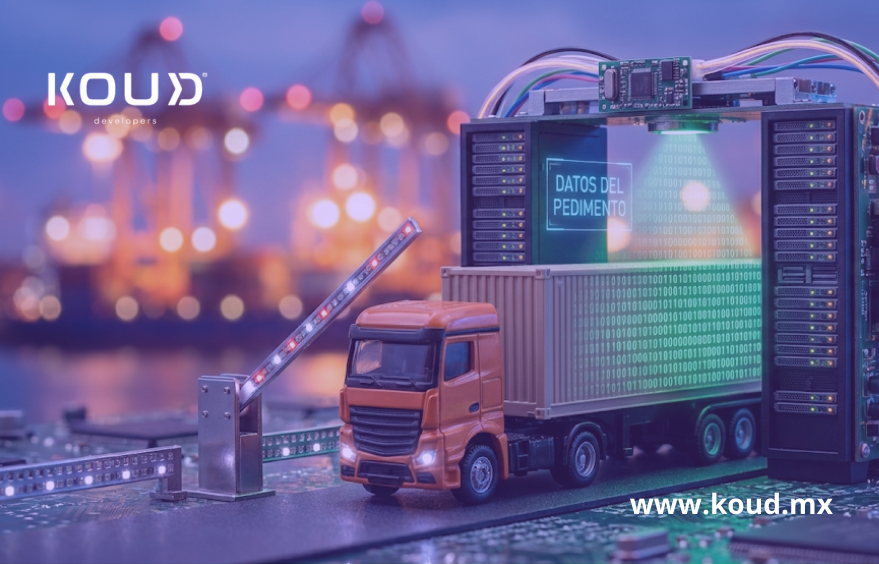
- Port Entry: Cameras with OCR (Optical Character Recognition) read the truck plate and container number.
- Data Cross-Check: The system queries in milliseconds if that container has its customs filing (pedimento) paid and modulated.
- Authorization: If everything is green (Fiscal Traffic Light), the barrier lifts, and the exit pass prints automatically. No human intervention. No errors.
The Koud Solution for High-Stakes Logistics (High Availability)
The port operates 24/7/365. Your software must do the same.
Unlike a corporate website or a blog, which if down for an hour means “no big deal,” if your logistics system goes down for an hour, you have stopped trucks, waiting ships, and million-dollar losses.
At Koud, we specialize in High Availability Architecture.
- Redundancy: We don’t rely on a single server. If the main server fails, traffic automatically redirects to a replica in milliseconds (Failover).
- Offline-First Mode: We know the signal in Veracruz yards is poor. Our mobile apps for yard operators work without internet, synchronizing data as soon as they regain connection.
Koud vs. Web Agencies:
A marketing agency will make you a system that looks pretty. We make industrial systems that withstand real workloads. We are not scared of dust, heat, or transaction volume.
Does your operation in Veracruz depend on an Excel sheet only one person understands?
That is an unacceptable operational risk.
Use Case: Veracruz-Bajío Cargo Traceability
The end client (the automotive plant in Bajío or the retail store in CDMX) lives with anxiety: “Where is my cargo?”
This generates hundreds of daily calls and emails to your traffic team.
We develop B2B client portals that offer Real-Time Traceability.
We integrate unit GPS and port system statuses into a single dashboard. Your client logs in, enters their reference number, and sees:
- “10:00 AM – Discharged from Vessel”
- “02:00 PM – Veracruz Yard Exit”
- “06:00 PM – In Transit (Orizaba)”
Tangible Benefit: 90% reduction in follow-up calls and increased customer loyalty due to transparency.
Frequently Asked Questions
Can your systems integrate with the Port Community System (SASP)?
Yes. We have experience consuming and sending data to port community systems to synchronize appointments and maneuvers, always complying with required security protocols.
How long does it take to implement a custom YMS?
It depends on the complexity of your yard (number of gates, types of merchandise). A robust system usually takes between 4 and 6 months. However, we can release functional modules (like access control) starting from month 2.
Does the software work for break bulk or just containers?
Our solutions are modular. We adapt the logic to handle containers (TEUs), break bulk, bulk, or even vehicles, depending on the vocation of your bonded warehouse.
Conclusion
In modern port logistics, slow software is lost money. You can no longer compete with companies moving cargo at the speed of data while you are still moving papers.
Modernize your infrastructure, secure your customs filings, and take control of your yard with Koud.
Do you need software architects who understand the difference between a BL and a Pedimento?
At Koud, we speak your operational language.