Buy vs. Build: The Ultimate Matrix for Deciding Your Software Investment
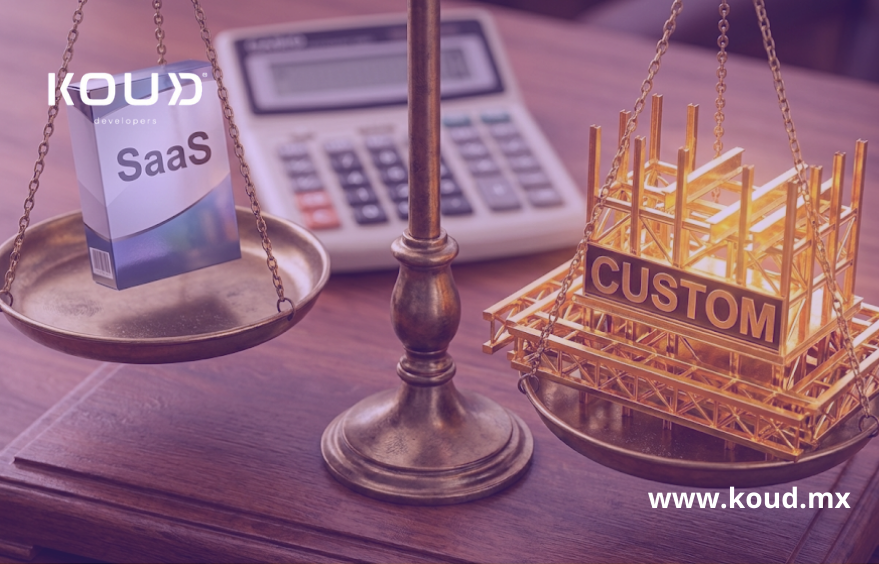
Buy vs build software
It is the eternal dilemma in the boardroom of any growing company: You have an operational problem (sales, inventory, logistics). Someone raises their hand and says: “There’s a SaaS that charges $50 USD a month that does that.” Another executive responds: “No, that limits us. We should hire developers and build our own platform.”
Who is right?
The wrong answer can break your cash flow (if you develop something unnecessary) or stagnate your growth for years (if you depend on rented software that doesn’t scale).
As strategic consultants, at Koud we apply a financial and technical golden rule: The Core Business Rule.
- Is the activity a “Commodity”? (Accounting, Internal Chat, Generic CRM). BUY. Do not reinvent the wheel. You are not going to beat Salesforce or Slack.
- Is the activity your “Competitive Advantage”? (Your pricing algorithm, your last-mile logistics, your unique user experience). BUILD. Never rent the engine that makes your business unique. If you use the same software as your competition, your only difference will be price, and that is a race to the bottom.
Decision Matrix: When to Build Custom Software?
Deciding between buy vs build software requires analyzing three critical factors: Customization, Integration, and Ownership.
1. Extreme Customization
Commercial software (SaaS) is designed for the “average” market. If your processes are standard, SaaS is perfect. But if your business process is your industrial secret, a SaaS will force you to change your process to fit the software. Custom development fits you like a glove.
2. Integration with Legacy
Many companies have old systems (On-premise ERPs) that lack modern APIs. Connecting a modern SaaS to a 20-year-old system is a nightmare of “patches.” Custom software can build the exact bridges you need.
3. Company Valuation
This is vital for Startups and companies seeking investment.
- If you use SaaS, your technology is an Operating Expense (OpEx). You own nothing.
- If you develop your IP, your technology is a Capital Asset (CapEx). The code is yours, the data is yours, and that increases your company’s valuation to investors.
Comparative Table: The Financial Truth
Variable | Commercial Software (SaaS) | Custom Development (Custom) |
Initial Cost | Low (Subscription) | High (Initial investment) |
5-Year Cost (TCO) | High (Perpetual rent + extra users) | Medium/Low (Maintenance) |
Implementation Time | Immediate | 3 to 6+ months |
Ownership (IP) | Provider’s (Rent) | 100% Yours (Asset) |
Flexibility | None/Low | Total |
The Koud Approach: Development That Generates Assets
When the strategic decision is BUILD, the risk changes. Now the danger is building poorly.
The common fear is: “If I develop, I get married to the programmers, and the code becomes spaghetti that no one understands.” That is true if you hire freelancers without methodology or cheap “software factories” that only want to bill hours.
At Koud, our approach is Asset Development.
- Clean and Documented Code: We write software thinking that another team will maintain it in the future. We use industry standards.
- Total Intellectual Property: At the end of the project, we hand over the repositories, the keys, and the documentation. You are the owner. We don’t hold you hostage.
- Scalability: We design architectures that support 100 users today and 1 million tomorrow, avoiding technical debt that forces a complete rewrite after two years.
The Hidden Cost of SaaS in the Long Run
Beware of the “low monthly cost” trap.
We have seen clients who hired a SaaS for $100 USD/month.
- Then they needed 50 more users: +$1,000 USD/month.
- Then they needed a feature the SaaS didn’t have, so they hired a plugin: +$200 USD/month.
- Then they needed to connect another system and paid an external consultant: +$5,000 USD.
In the end, they are paying $30,000 USD a year for software that isn’t theirs, that doesn’t do exactly what they want, and if they stop paying for a month, shuts down their business.
In these cases, custom development has a positive ROI in less than 18 months and frees you from perpetual rent.
Frequently Asked Questions
Is a hybrid strategy possible?
Absolutely. It is the smartest move. You can use a SaaS for your CRM (Salesforce) and custom build a “Middleware” or Customer Portal that connects to that CRM. Koud specializes in these integrations so you get the best of both worlds.
How long does custom development take?
It depends on the scope. A well-defined MVP (Minimum Viable Product) can be ready in 3-4 months. A full Enterprise system can take 8-12 months. The important thing is to use agile methodologies to have functional deliverables every 2 weeks.
What about maintenance of proprietary software?
Software is like a car; it needs service. You must budget an annual maintenance cost (usually 15-20% of the development cost) for security updates and servers. Koud offers maintenance policies so you don’t have to hire an internal team just for that.
Conclusion
There is no single answer, but there is a correct strategy. The buy vs build software strategy defines your future.
If your software is a commodity, buy.
If your software is your business, build.
Do you need a technology partner to help you build assets and not liabilities?
At Koud, we turn your business vision into code owned by your company. Request a strategic diagnosis session with a CTO