B2B E-commerce: Why Shopify/WooCommerce Aren't Always Enough
B2B ecommerce development
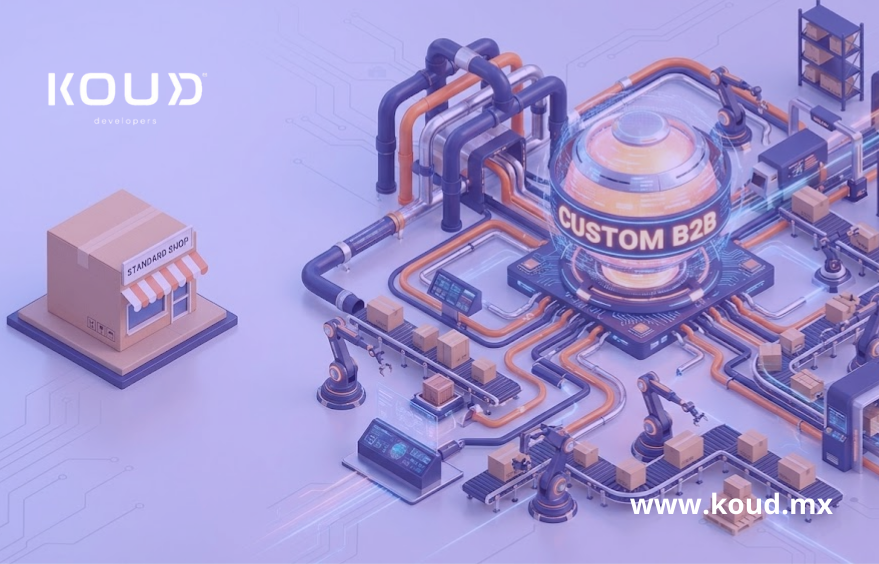
We live in the golden age of e-commerce. Tools like Shopify, WooCommerce, or VTEX have democratized online selling, allowing any clothing or electronics brand to set up a shop in a matter of hours. They are fantastic tools… for selling to the end consumer (B2C).
But you don’t sell t-shirts one by one. You are a distributor, a factory, or a wholesaler. Your clients buy by the pallet, negotiate volume prices, and pay on 60-day credit terms.
When you try to force this logic into a standard template, you start to suffer. At Koud.mx, we have seen too many commercial managers frustrated trying to manage complex B2B ecommerce development using tools designed for simple sales. Here is why there comes a point where “installing another plugin” is no longer the solution.
The Dilemma of “Complex Business Rules”
In B2C, the price is the price. If the shirt costs $50, it costs $50 for everyone.
In B2B, the price is a variable.
- Client A has “Platinum” status and pays $40.
- Client B has an old contract and pays $42.
- Client C buys in dollars but pays in pesos at the daily exchange rate.
Trying to manage these complex business rules on standard platforms requires installing dozens of plugins that often conflict with each other, making your site slow and unstable. Custom B2B ecommerce development (or a Headless architecture) allows you to program these rules directly into the core of the system, without patches.
Credit, Collections, and the “Checkout” That Isn’t a Checkout
In a normal store, you pay with a card and leave. In your business, “payment” is often a Purchase Order (PO) that is invoiced later.
You need a wholesale sales platform that understands concepts like:
- Available credit limit (and automatic blocking if exceeded).
- Payment terms (Net 30, Net 60).
- Order approval levels (the client’s purchasing manager authorizing their employee’s order).
If your current platform forces you to treat your distributors as if they were retail shoppers, you are losing sales due to operational friction.
“Full Truckload” vs. “Parcel” Logistics
Shopify is great at calculating DHL or FedEx shipping. But what happens when your shipment requires a 3.5-ton truck, leaves from 3 different warehouses, and needs a bill of lading?
Professional B2B ecommerce development integrates deeply with your WMS (Warehouse Management System) to calculate real heavy cargo logistics, something that “free shipping over $50” plugins cannot handle.
ERP Integration: The Holy Grail
Finally, the breaking point is usually synchronization. Your ERP (SAP, Oracle, NetSuite) is the absolute truth of your business.
Commercial platforms often have basic connectors that fail when data volume is high (e.g., 50,000 SKUs with prices changing every hour).
At Koud, we build real-time bidirectional integrations. If stock changes in the physical warehouse, it changes on the web instantly. No manual CSV files, no overselling errors.
Frequently Asked Questions
Is custom development much more expensive than Shopify Plus?
The initial investment is usually higher in custom development, yes. However, Shopify Plus has recurring monthly costs (thousands of dollars) and transaction fees that, in the long run, can be more expensive for a wholesaler with tight margins. Custom B2B ecommerce development is a capital expenditure (CAPEX) that gives you total ownership of the code and zero sales commissions.
Can I have my B2C and B2B store in the same place?
Yes, and it is ideal. With proper architecture, you can have a single product catalog. If an anonymous user enters, they see public prices (B2C). If a distributor logs in, the wholesale sales platform changes the interface to show their contract prices and credit options (B2B). All managed from a single dashboard.
How long does it take to develop a custom B2B platform?
It depends on the complexity of your complex business rules. A robust project with ERP integration usually takes between 3 to 6 months. The key is to define the initial requirements well to avoid rework.
Conclusion
Shopify and WooCommerce are excellent for starting out or for direct business models. But if your operation involves infinite price lists, industrial logistics, and corporate credit, you are trying to fit an elephant into a compact car.
Your wholesale business deserves a platform that adapts to your rules, not the other way around.
Is your E-commerce limiting your growth?
Stop fighting with plugins that don’t do what you need. At Koud.mx, we are specialists in high-complexity B2B ecommerce development. Let’s build the portal your distributors will love to use.