MLOps: Why Your AI Works in the Notebook But Fails in Production
What is MLOps
This is the most common scenario in the industry today: A brilliant team of Data Scientists spends months building a fraud prediction model. The team leader presents the results to the CEO: “The model has 99% accuracy on our test data. It’s perfect.” There was applause.
Three months later, the model is still not being used by the operations team. The code lives in a Jupyter Notebook file (.ipynb) on the scientist’s laptop. The IT team doesn’t know how to integrate that “strange” Python code with the main Java-based application. When they finally try to put it into production, the model behaves erratically or is too slow.
This gap is why 85% of Artificial Intelligence (AI) projects fail before reaching production. The problem is not the math; it is the engineering.
There is a critical concept presented by Google in a famous paper: the hidden technical debt in ML systems. The code that does the “magic” (the Machine Learning algorithm) is barely 5% of a real AI system. The other 95% is the infrastructure needed for that code to ingest data, run, scale, and be monitored in the real world.
If you want your AI investment to generate real money, you need MLOps.
The “Model Drift” Problem (Model Degradation)
Unlike traditional software, where code only changes when you touch it, Machine Learning models degrade by themselves over time, even if you don’t touch a single line. Why? Because the world’s data changes.
This phenomenon is called Model Drift.
- Practical Example: Imagine a model trained in 2019 to predict product demand in supermarkets. If you used that same model in 2020 during the pandemic, its predictions were garbage, because people’s consumption habits changed radically overnight.
If your AI strategy does not include an automatic system to detect that the model has become “dumb” and retrain it with fresh data, you are operating blindly. A static model is a liability, not an asset.
The Solution: Automated Pipelines with Koud
What is MLOps? It is the application of DevOps practices (Continuous Integration, Continuous Deployment) to the world of Machine Learning.
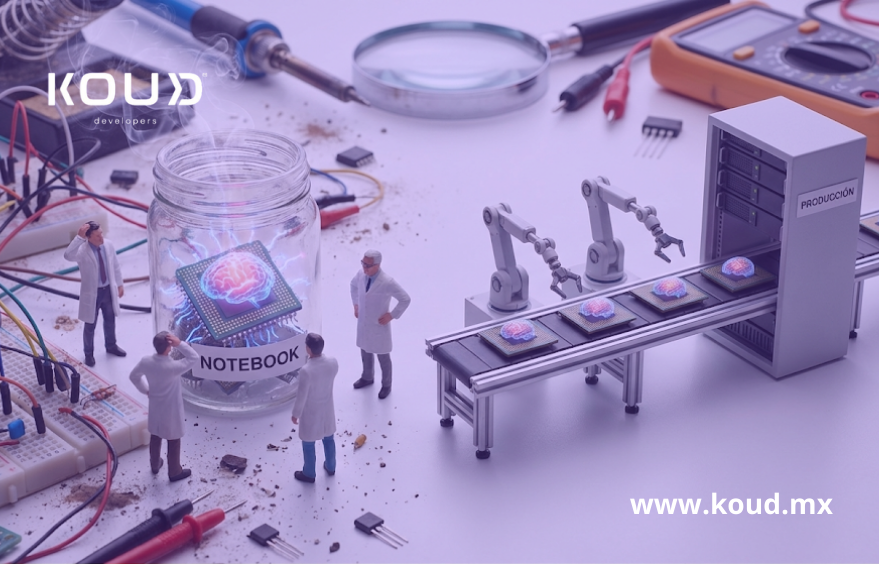
At Koud, we understand that you don’t just need the algorithm; you need the factory that produces the algorithm. Our MLOps approach focuses on automation and reproducibility.
The Koud Data Engineering Approach:
- Containerization (Docker): We package not just the model, but its entire environment (library versions, operating system) into a Docker container. This eliminates the dreaded “it works on my machine.”
- Data Pipeline (CI/CD for Data): We build automated pipelines using tools like Kubeflow or AWS SageMaker. When new data arrives in the Data Lake, the pipeline triggers automatically, preprocesses the data, retrains the model, validates it, and, if it outperforms the previous model, deploys it to production.
Koud vs. Pure Data Consultancies:
Many firms will deliver an excellent mathematical model in a loose Python file and leave, leaving you with the problem of how to use it. At Koud, we apply the discipline of Software Engineering to Data Science. We deliver a living system, not a dead file.
Real Example: Retail Recommendation System
Let’s analyze what this looks like for a Koud client selling clothing online:
- The Problem: Their recommendation system (“Other users also bought…”) was updated manually once a month. When a new season arrived (e.g., Summer), the system kept recommending winter coats for weeks.
- The MLOps Solution: We implemented a continuous training pipeline. The system monitors the real-time Click-Through Rate (CTR) of the recommendations.
- The Result: When the pipeline detects that the CTR drops below the acceptable threshold (a signal that the recommendations are bad), it automatically triggers a retraining with sales data from the last 24 hours. Model update time went from 4 weeks to 4 hours, without human intervention.
Frequently Asked Questions
Do I need MLOps if I only have one model?
If that model is critical to your business, yes. The complexity of keeping it updated, monitoring it, and scaling it if your users double justifies the investment in solid infrastructure from the start.
What tools does Koud use for MLOps?
We are cloud-agnostic. We work with native ecosystems (AWS SageMaker, Azure ML, Google Vertex AI) or with open-source tools on Kubernetes (like Kubeflow or MLflow), depending on your current infrastructure and budget.
How do you monitor a model in production?
It is not enough to see if the API responds. We monitor data metrics such as “Data Drift,” comparing the statistics of incoming real-time data against the data with which the model was trained, alerting if reality is changing too fast.
Conclusion
MLOps is the necessary bridge between the mathematical “magic” of Artificial Intelligence and the operational reality of your business. Without that bridge, your AI investments will remain costly lab experiments.
Do you need engineers who understand both neural networks and container orchestration?
At Koud, we offer Staff Augmentation with Top 3% ML and Data Engineers who know how to take models to production.
Quote your Data and AI team today